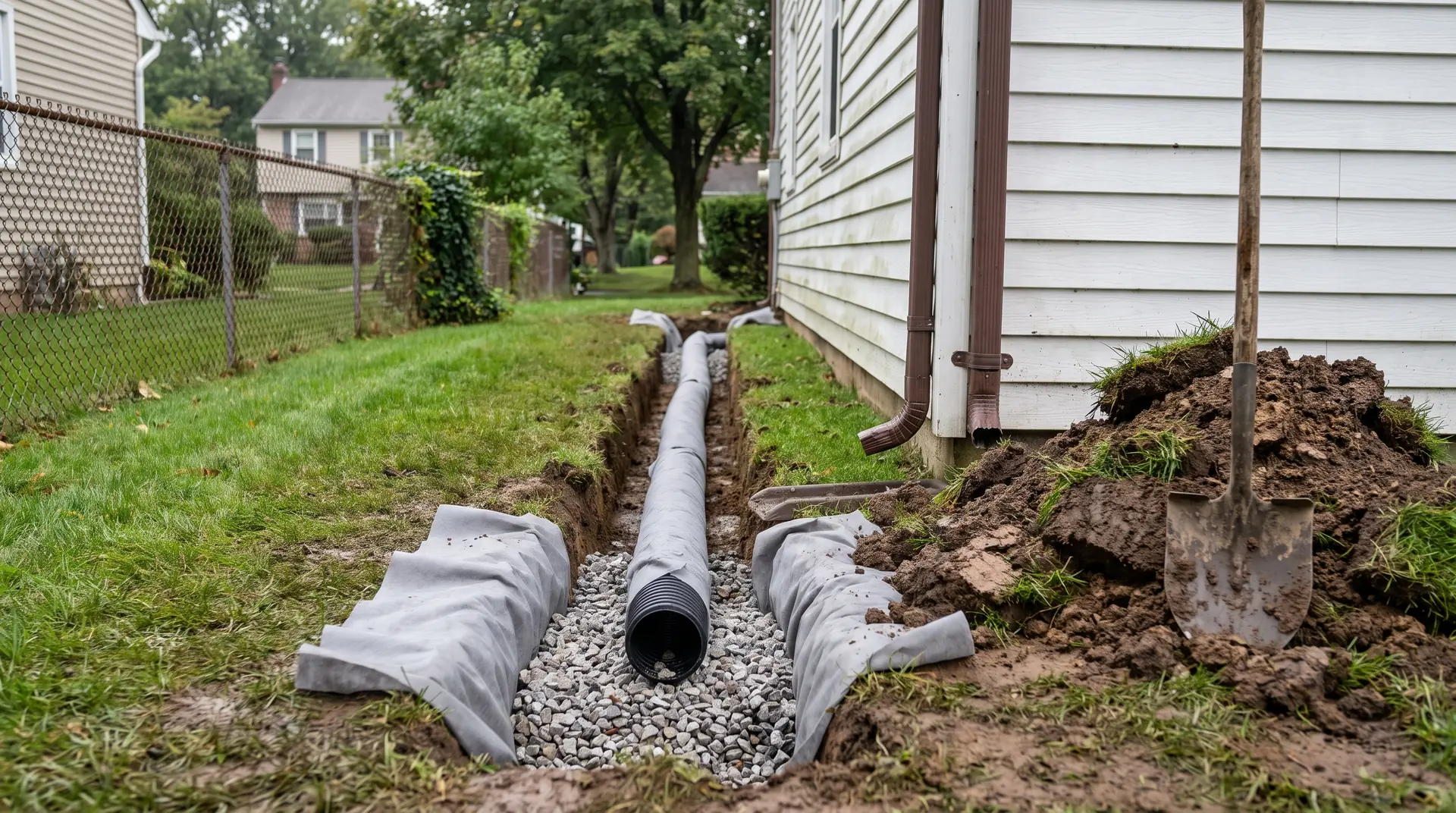
Fabric-wrapped perforated pipe on gravel in a trench beside a house
Calls answered 24/7

French Drains in Hackensack NJ

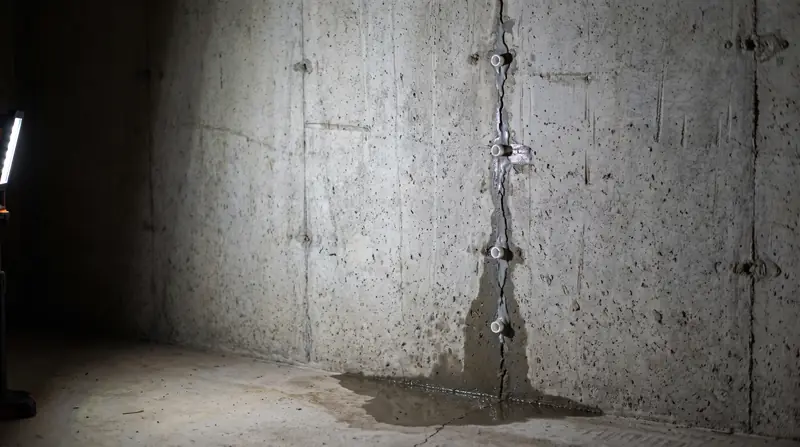
A strip of wet floor along one basement wall, or a lawn that stays a puddle for days? A drain gives that water an easier path, to a sump or away from the house.

Number for Waterproofing & Sump Pumps

Calls answered 24/7. No obligation to book.

Undercroft Restoration is a free referral service, not a restoration company. Calls are connected to independent local service providers that serve your area, and calls may be recorded. The work is done by those providers, not by this site.

  • One Call Connects You
  • No Obligation to Hire
  • Calls Answered 24/7
  • Water Routed Away
~8,100Monthly U.S. searches asking what it is
36.2%Hackensack homes built 1940 to 1969
~47 in.Rain a year in Hackensack
ClaySlow-draining soil under the valley
01

What French Drains Are, in Plain Words, and Why Bergen County Clay Makes Them Common

Strip away the name and it's simple: a trench, a perforated pipe, and gravel. The pipe has holes or slots along it. It sits in a bed of washed stone, and the whole thing is usually wrapped in filter fabric so soil doesn't wash in and clog it. The trench slopes gently toward an outlet, either a sump pit that pumps the water out, or a spot downhill where it can drain away on its own.

Water always takes the easiest path. Loose gravel and an open pipe are a much easier path than soaked clay, so groundwater that would have pushed against your foundation or sat in your yard flows into the drain instead and gets carried off.

That's why they're so common around here. Much of the Hackensack valley sits on old glacial lake clay that drains slowly and holds water near the surface after a rain. The full story of why local basements leak is on the basement waterproofing page. The short version: when the soil won't move water away from your house, you give the water a pipe.

02

French Drain Installation Inside the Basement: Cutting the Slab Along the Walls

For a basement that takes water, the most common fix in Bergen County is an interior French drain, sometimes called interior drain tile. It's installed from inside, so nothing outside gets dug up.

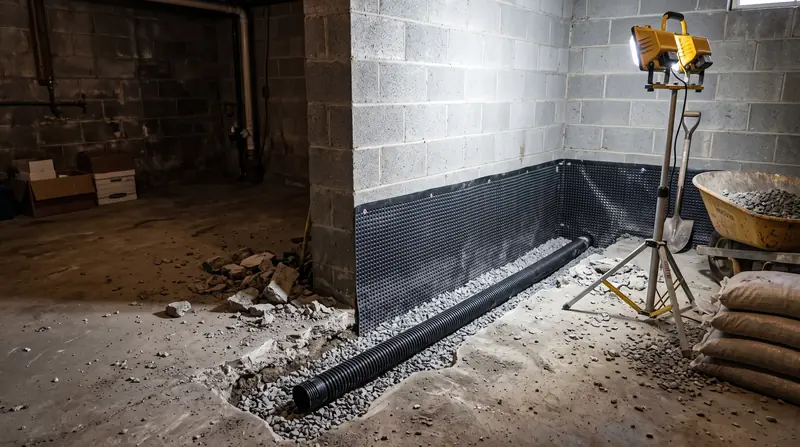
A crew breaks out a strip of the concrete floor, usually about a foot wide, along the walls that leak. They dig a trench below the slab, lay perforated pipe in gravel, and slope it to a sump pit in a corner. A plastic membrane often goes up the wall and tucks into the trench so water running down the wall drops straight into the drain. Then the trench is covered with new concrete. The drain doesn't stop water reaching the wall. It catches the water the moment it arrives and sends it to the pump.

01

A Basement French Drain for Block Walls That Weep

About 36 percent of Hackensack homes were built between 1940 and 1969, and many have concrete block foundations. Block walls are hollow, and the cores fill with water in a wet season. A basement drain for block walls usually includes small weep holes drilled into the bottom course of block, so water trapped in the cores drains into the trench instead of seeping out across the floor.
02

Finished Basements: Drains Behind Walls Without Tearing Everything Out

If your basement is already finished, a drain is still possible, but the bottom of the wall has to come off to reach the floor along the foundation. Many contractors remove the lower part of the drywall and framing rather than the whole wall, install the drain and membrane, then rebuild. Ask how much of the finish will come out and who puts it back.

03

Outside the House: Footing Drains, Exterior French Drains and the Yard

Drains outside the house do a different job. Some protect the foundation from the outside. Others handle water on the surface of the yard.

A footing drain is a perforated pipe laid alongside the bottom of the foundation, at the footing, outside the wall. Many houses were built with one. Installing or replacing it means excavating down to the footing, which is a big job: walkways, patios, plantings and sometimes driveways come up. On tight Hackensack lots and shared driveways, there often isn't room to dig. When there is, it keeps water off the wall entirely.

01

Old Clay Tile Footing Drains Under 1940s to 1960s Homes

Many houses from the 1940s to 1960s were built with footing drains made of short clay tile sections laid end to end. After 60 or 70 years, those old basement drainage systems are often clogged with silt, crushed, invaded by roots, or disconnected from wherever they once drained to. A house that stayed dry for decades and then started leaking is a classic sign the original footing drain has quit.

02

Yard Drains for Water Pooling Against the Foundation

If water pools against the house after rain, start with the simple fixes: clean the gutters, extend the downspouts several feet from the foundation, and regrade the soil so it slopes away from the house. Those cost little and solve a lot. If the yard still holds water, a shallow drain across the low spot can carry surface water away, as long as it has somewhere legal to go.

04

French Drains vs Sump Pumps vs Grading: Which Problem Each One Solves

People mix these up, and each one does a different job:

  • Grading, gutters and downspouts keep rain from reaching the foundation in the first place. Always fix these first.
  • A drain collects groundwater that does reach the foundation or the floor, and moves it somewhere.
  • A sump pump lifts that collected water out of the basement, because a drain below the floor can't flow uphill to the yard on its own. See the sump pump page.

Most interior basement drains need all three: good grading outside, the drain inside, and a pump at the end of it.

05

French Drain Installation Step by Step in a Hackensack Basement

Here's what a proper interior job looks like.

01

Step 1: Find Where Water Enters and Where It Can Discharge

The contractor should show you where water is coming in, which walls, the floor joint, a crack, before recommending a drain. Then, where the pumped water will go:

  • Never into the sanitary sewer. Many New Jersey towns ban it; River Edge's Ordinance #1080, for example, prohibits hooking sump pumps or foundation drains to the sanitary sewer. Under N.J.A.C. 7:14A-22.16, sewer operators near capacity or tied to combined sewers must plan to cut this kind of inflow, which is why towns pass their own bans.
  • In Hackensack, city code §141-23 allows only stormwater into the city storm sewer, and §141-12 requires a city permit for private sewer work in a street. Any tie-in to city drainage needs the city's approval.
  • The usual answer: onto your own lawn, a garden bed or a drywell, away from the foundation and away from neighbors' property and sidewalks, where it can freeze in winter.
02

Step 2: Trench, Pipe, Gravel and Fabric

The floor is cut and broken out along the wall, the trench is dug below the footing level where possible, and perforated pipe goes in on a bed of washed stone, wrapped in fabric, sloped toward the pit. Weep holes go into block walls, and a wall membrane is added if planned.

03

Step 3: Connect to the Sump and Test With Water

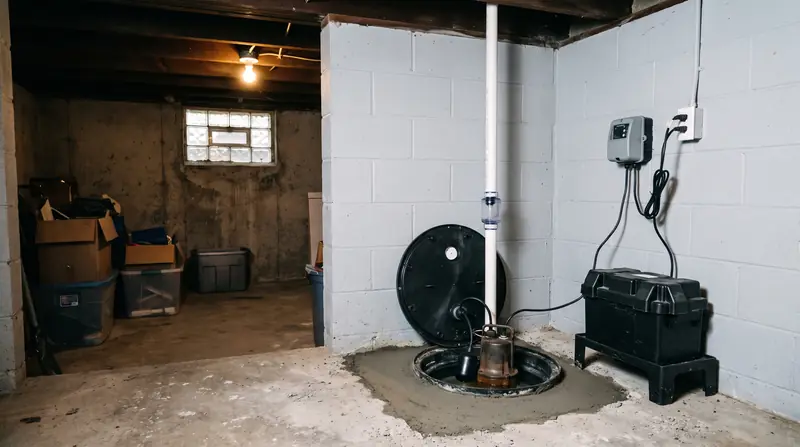
The drain runs into a sump pit with a pump, a check valve and a discharge line to the planned outlet. Before any concrete goes back, the crew should run water into the trench and watch it reach the pit and pump out.

04

Step 4: Patch the Floor and Leave a Cleanout

New concrete covers the trench. A good installation leaves a cleanout, an access point where the pipe can be flushed later, so silt can be cleared without breaking the floor again.

06

Before You Sign for Drainage Work in New Jersey: Registration, Contract and Warranty

Drain work is home improvement work under New Jersey law. The Division of Consumer Affairs checklist says contractors must register every year and show the registration number on ads, contracts and vehicles. For all but very small jobs, the contract must be in writing, with start and completion dates and insurance details. You can cancel before midnight of the third business day after receiving the contract. Get any warranty in writing, and read what it excludes: pump failure, power outages and surface water are common exclusions.

01

Drainage Company or Landscaper? Ask Who Digs to the Footing

Waterproofing companies range from local crews to large multi-state operators based far from Bergen County, and some websites swap in a town name with nothing local behind it. Landscapers also install yard drains, which is fine for surface water but different from basement work. Ask where the company is based, whether it has worked on Bergen block basements, and who actually digs.

02

How Undercroft Restoration Calls Work: You're Connected With a Local Drainage Contractor

Undercroft Restoration is a referral service. When you call (201) 377-3819, you're connected with an independent, third-party contractor that serves your area. That company inspects, quotes and does the work. Undercroft Restoration doesn't do the work, set prices, hold contractor registrations or offer warranties. For how the line works across every service, see the home page.

07

One Wet Wall, One Clogged Footing Drain: A Bergen County Drain Job

About this example. Undercroft Restoration connects callers with independent companies and doesn't publish their customers' jobs. This is an illustrative example, not a record of a real job. It's built from Hackensack housing data (homes built 1940 to 1969) and the common failure of original clay tile footing drains.

A 1955 Cape Cod in Bergen County. For 30 years the owners' basement stayed dry. Then, over two wet springs, one wall started showing a wet line at the floor after every heavy rain, and white crust appeared on the lower block.

A contractor runs a camera into the old footing drain through an outside cleanout. The clay tile sections are packed with silt, and one section has collapsed under the downspout. The drain hasn't worked for years; the ground has just been getting wetter.

Digging outside isn't practical because a concrete driveway runs along that wall. So the fix is an interior drain along that one wall, weep holes in the bottom course of block, and a new sump pit with a pump and a battery backup. The discharge line runs to a drywell in the back yard. The downspout gets extended well away from the house.

The next storm, water shows up in the sump pit instead of on the floor.

The lesson: a basement that suddenly starts leaking after decades often has an old drain that finally quit.

08

The Rest of a Dry Basement: Waterproofing, Sump Pumps and Cracks in Bergen County

09

Drainage Calls From Hackensack 07601 and Across Bergen County

Calls come from Hackensack's single-family streets in the Fairmount section and the Johnson Avenue area, and from the block-basement suburbs across the county. Calls from Teaneck, Paramus and Fort Lee are connected the same way. More on water damage in Hackensack and the full Bergen County service area.

Call any time

Water Along the Wall Again? Call and Get Connected With a Bergen County Drainage Contractor

Calls answered 24/7. Have your town and where the water shows up ready when you call.

Undercroft Restoration is a free referral service, not a restoration company. Calls are connected to independent local service providers that serve your area, and calls may be recorded. The work is done by those providers, not by this site.

Questions

What Bergen County Homeowners Ask About French Drains

Still have a question?

Calls answered 24/7. Pick the number for your problem, then say your town and what happened.

What is a French drain?

It's a trench with a perforated pipe in gravel, usually wrapped in filter fabric and sloped to an outlet. Groundwater flows into the gravel and pipe instead of pushing against the foundation or pooling in the yard, and it's carried to a sump pump or a safe spot downhill.

Do French drains work in clay soil?

Yes. Clay drains slowly, which is exactly why a drain helps: it gives water a faster path than the soil does. Filter fabric keeps fine clay from clogging the pipe, and a correct slope keeps water moving.

Inside or outside: which drain do I need?

For groundwater coming into an existing basement, an interior drain with a sump is the usual choice. For water pooling in the yard, fix grading and downspouts, then consider a yard drain. Exterior footing drains make sense where you can dig.

What affects French drain installation cost?

How many linear feet are needed, whether it's inside (slab cutting) or outside (digging to the footing), whether a sump pit and pump are included, finished walls that have to come out, and access. Call (201) 377-3819 and ask for a written scope before any work starts.

How long does an interior drain take to install?

Usually a few days for a typical basement, depending on how many walls, the floor thickness, and whether a new sump pit is needed. Finished basements take longer.

Can these drains clog?

Yes, over time, especially without filter fabric or where roots get in. A cleanout lets the pipe be flushed. Old clay tile footing drains are the ones most likely to be clogged or collapsed.

Does the drain need a sump pump?

An interior drain below the floor almost always does, because water can't flow uphill to the yard. A yard drain on a slope may drain by gravity to a lower spot.

Can I install one myself?

A shallow yard drain is a reasonable DIY project if you have somewhere legal for the water to go. Cutting a basement slab, drilling block and installing a sump is a professional job.

Where can the drain discharge in Bergen County?

Not into the sanitary sewer; many towns ban it. Usually onto your own lawn, a bed or a drywell, away from the foundation and neighbors. Any tie-in to city storm drainage needs the town's approval.

Will a drain stop basement mold?

It removes the water that feeds basement mold. Mold that's already growing still needs to be removed, and humidity still needs to stay between 30 and 50 percent. See basement mold.

Call (201) 377-3819Waterproofing