Calls answered 24/7

Fire Damage Restoration in Hackensack NJ

Fire's out, but the house reeks of smoke and hose water is dripping through the ceiling. One call covers fire damage and restoration, from board-up to a house that smells like home again.

Number for Water Damage, Fire, Mold & Sewage

Calls answered 24/7. No obligation to book.

Undercroft Restoration is a free referral service, not a restoration company. Calls are connected to independent local service providers that serve your area, and calls may be recorded. The work is done by those providers, not by this site.

  • One Call Connects You
  • No Obligation to Hire
  • Calls Answered 24/7
  • Fire, Smoke and Water
48%Of U.S. home fires involve cooking
Dec to FebWhen almost half of heating fires happen
~52%Of Hackensack homes built before 1970
6 p.m. to 8 a.m.No public adjuster solicitation, first night (NJ)
01

Fire Damage Restoration Services for Hackensack's Pre-1970 Homes, Two-Families and Prospect Avenue High-Rises

A fire leaves three problems behind, not one. There's the burned room. There's smoke and soot in rooms the flames never reached. And there's the water the fire department used to put it out, soaking down through the floors.

A proper crew handles all three in one job:

  • Board-up and roof tarps over broken windows, forced doors and vent holes.
  • Water extraction and drying where the hoses ran.
  • Tear-out of charred drywall, insulation and flooring.
  • Soot cleaning and odor control in every room the smoke reached.
  • Contents cleaning or pack-out for clothes, furniture and keepsakes.
  • Photos, inventories and a written scope your insurer can work from.

Hackensack's housing makes smoke travel. About half the homes were built before 1970, and roughly 15 percent before 1939, when many wall cavities ran open from the basement to the attic. Smoke rides those gaps from floor to floor. In two-families it slips through shared walls and stairways. In the Prospect Avenue high-rises it follows hallways and shafts, so units several floors away can smell of a fire they never saw. And with about 64 percent of Hackensack households renting, a lot of fire jobs involve a landlord, a tenant and two insurers at once.

02

Emergency Fire Restoration in Hackensack: What to Do Before the Smoke Clears

What to do after a house fire: get everyone out and stay out until the fire officials release the building. Don't switch gas or power back on yourself. Call your insurer, photograph everything from a safe spot, keep every receipt, and get the openings in the house covered before the weather or anyone else gets in.

01

Wait for the Fire Official's Release, Then Let PSE&G Restore Gas and Power

After a house fire in Hackensack, the city's fire prevention office investigates, as it did after a Fairmount Avenue fire in July 2025. Until the building is released, it's a fire scene, and nobody should be inside collecting things.

Firefighters often shut off the gas and electric. Leave them off. PSE&G restores service, and if wiring was damaged, the town may need an electrical inspection before the power comes back on. Ask the construction office what it needs.
02

Fire Board Up and Roof Tarps for the Holes Crews Cut to Vent the Roof

Putting a fire out means opening the house. At a Hackensack house fire on December 20, 2025, Hackensack and Englewood crews laddered the roof and ventilated it, while hoselines went through the front door to both floors. That's normal work, and it leaves holes.

Emergency board up of broken windows and doors, plus a tarp over the roof, keeps rain, animals and thieves out. New Jersey's Department of Banking and Insurance tells policyholders to make temporary repairs that protect the property from more damage, and to keep the receipts. Board-up is exactly that.

03

A Knock on the Door at 2 a.m.? New Jersey Bars Public Adjuster Solicitation Overnight

New Jersey law, N.J.S.A. 17:22B-13, says nobody may solicit you to adjust your claim between 6 p.m. and 8 a.m. during the first 24 hours after a loss. A 2023 state enforcement order describes exactly what the rule is for: a fire at about 1 a.m., and representatives of a public adjusting firm at the house around 2 a.m. with a contract to sign (a violation the order alleges).

So don't sign a public adjuster contract that night. Public adjusters are licensed by the state and can help on a big claim, but that's a decision for a calm morning, after you've read the fee terms.

One paper you may sign that night is normal: an emergency work authorization from the restoration company, so it can board up, tarp or pull out water. Read it. Check that it covers emergency work only, not the whole rebuild. Keep a copy.

04

Red Cross Help, a Hotel Room and Your Policy's Additional Living Expenses

After recent fires in Teaneck and Englewood, the Red Cross gave displaced families temporary lodging, food and clothing. If you can't sleep at home, check your policy for additional living expenses. The state's insurance department tells policyholders to keep every receipt and send copies to the insurer.

Smoke still in the house? Call (201) 409-9820. Calls answered 24/7. You're under no obligation to book.

Call (201) 409-9820
03

Fire and Smoke Damage Restoration: The Soot and Odor That Spread Past the Burned Room

The burned room is easy to see. The smoke damage is the part people underestimate. Smoke is hot, it rises, and it pushes into every room with an open door, every closet and the cavities behind the walls. When it cools, it leaves residue on everything it touched.

The industry standard for this work, the ANSI/IICRC S700 published in January 2025, covers assessing smoke residue and odor in the building, its heating and air systems and its contents, including smoke from a fire in an adjoining or nearby building.

01

Dry, Wet, Protein or Fuel Oil: Four Kinds of Smoke Residue in North Jersey Homes

  • Dry smoke comes from fast, hot fires in paper and wood. It's powdery and the easiest to clean.
  • Wet smoke comes from slow, smoldering fires in plastics, foam and rubber. It's sticky, smears when touched and smells strong.
  • Protein residue comes from burned food. It's almost invisible, yellows paint and cabinets, and leaves the worst smell of the four.
  • Fuel oil soot comes from an oil burner puffback. It's black, oily and coats everything, which is why puffbacks get their own section below.

Each type needs a different cleaning method, so the first job is figuring out which one you have, room by room.

02

Soot Cleaning Starts Dry: Why a Wet Rag Smears It Into the Paint

Wiping soot on walls with a damp cloth is the most common mistake after a fire. Water and soap push the residue into the paint and leave a gray smear that's harder to remove than the soot was.

Proper soot cleaning starts dry: a HEPA vacuum to lift loose soot, then dry chemical sponges (dense rubber sponges that grab residue without water). Wet cleaning comes last, with a cleaner matched to the residue type. Until then, don't touch the walls, don't sit on soot-covered furniture, and don't run the heat or air conditioning.

03

Acidic Soot Starts Etching Chrome, Grout and Appliance Finishes Within Days

Soot is acidic. Left on surfaces, it starts to pit chrome fixtures, discolor grout, cloud glass and stain appliance finishes, and the longer it sits, the more that's permanent. The fire may be out, but the clock on the cleanup is still running. That's the main reason to get cleaning started within days, not weeks.

04

Smoke Odor Removal With Air Scrubbers, Thermal Fogging and Hydroxyl, and Why Ozone Needs an Empty House

Smell comes from residue. Smoke odor removal starts with removing burned materials and cleaning surfaces, because no machine fixes a smell that's still sitting on the walls. After that, crews use:

  • HEPA air scrubbers to pull fine particles out of the air.
  • Thermal fogging, a heated deodorizer that follows the same paths the smoke took.
  • Hydroxyl generators, which can usually run while people are in the house.
  • Odor-sealing primer on cleaned framing and walls before anything is closed up.

Ozone generators are a different story. The EPA says inhaled ozone "can damage the lungs" and that no federal agency has approved these machines for occupied spaces. If a crew uses ozone, the house must be empty, people and pets included, until it's aired out.

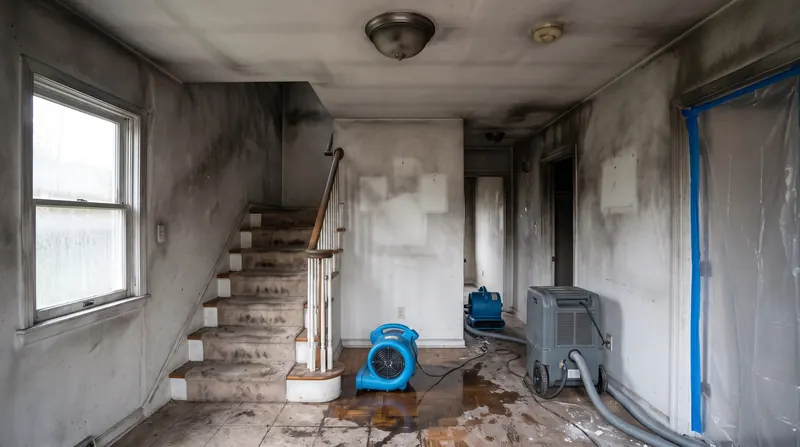
Soot-stained stairway and hallway in a two-story house, with air movers and a dehumidifier drying the floor and plastic sheeting taped over a doorway
05

Smoke Rides the Ductwork, the Attic and the Shared Walls of a Hackensack Two-Family

Forced-air systems pull smoky air in and push it back out into every room. After a fire, change the filter before the system runs again and have the ducts inspected and cleaned. Attics trap smoke too, in the insulation. In a two-family, check the other unit even if it never burned: smoke through a shared wall or stairway can leave its own soot film and smell.

04

Oil Furnace Puffback: A Soot Disaster in an Older Bergen County Home, With No Flames at All

Many older Bergen County homes still heat with an oil boiler or furnace. When an oil burner misfires, fuel can build up in the combustion chamber and ignite all at once. That small explosion is a puffback, and it blows oily soot out of the burner, through the flue and ductwork, and into rooms on every floor.

No flames, no fire trucks, and still a house full of fine black film: on ceilings, curtains, carpet, clothes in the closets. It often shows up first as dark streaks around vents and in cobwebs.

Two calls to make:

  • The oil company or a heating technician to find out why the burner misfired and fix it before it runs again.
  • A cleanup crew for the soot. Puffback cleaning is fuel oil residue work, the hardest kind to clean, and it usually means every room, the ducts and the contents.

Insurers usually treat a puffback as a sudden event, but policies differ, so check yours and photograph the soot before cleaning starts.

05

Kitchen Fire Cleanup: Grease, Extinguisher Powder and the Smell That Won't Leave the Cabinets

Cooking equipment is involved in about 48 percent of U.S. home fires, according to the National Fire Protection Association's 2020 to 2024 averages, and Thanksgiving is the peak day for cooking fires, with Christmas close behind. Most are small. The cleanup isn't.

Kitchen fire damage is mostly protein residue: a thin, greasy film you can barely see that holds a heavy smell and yellows paint and cabinet doors. Cabinet interiors, the range hood, the ductwork above it and the room's ceiling all need cleaning, not just the stovetop.

If someone used a dry chemical extinguisher, the powder spreads far. For fire extinguisher cleanup, vacuum it up first and don't wet it into a paste. Keep it off electronics until they're checked.

Food is simpler: throw it out. USDA guidance says to discard food exposed to heat, smoke fumes or firefighting chemicals, including food in the refrigerator, because fridge seals aren't airtight.

06

Fire and Flood Restoration: The Hose Water Left in Ceilings, Floors and Basements Below

A single room fire can still mean a lot of water. At that December 2025 Hackensack fire, crews ran two hoselines, one to each floor. That water doesn't stay put. It runs through floor boards into the ceiling below, down wall cavities and into the basement, carrying soot with it.

So fire jobs are water jobs too. The wet areas get the same treatment as any other leak: extraction, then dehumidifiers and air movers with daily moisture readings. The EPA's guidance is to dry wet materials within 24 to 48 hours to keep mold from starting. The water side of fire and water damage restoration is handled the same way as a burst pipe leak, and the drying is covered on the water mitigation page.

Sprinkler Discharge in Downtown Hackensack's Newer Apartment Buildings

The newer apartment buildings downtown have fire sprinklers, and they save lives. They also make fire sprinkler water damage a common call in stacked buildings: one head can soak the unit it protects and the units below it. Each unit needs its own photos and moisture readings, because each one may involve a different owner, tenant and policy.

07

The Fire Restoration Process, From the Fire Official's Release to a Final Odor Check

Here's what a proper job looks like, step by step, and what to ask at each one.

01

Step 1: Walkthrough and a Written Scope Under the IICRC S700 Fire Standard

The crew walks every room and identifies the residue type and how far it spread, including closets, the attic and the ductwork. Photos go first, before anything moves. You should get a written scope (the S700 standard calls it a restoration work plan) that says what will be cleaned, what will be removed and why.

02

Step 2: Board-Up, Tarp and Hose Water Out Before Anything Else

Openings get covered, the roof gets tarped, and standing water comes out. If there's water in the basement, that's emergency water removal work, and it can't wait for the insurance adjuster.

03

Step 3: Fire Damage Cleanup, With Charred Drywall, Insulation and Flooring Removed

Anything charred, heat-blistered or soaked comes out: drywall, insulation, flooring and cabinets past saving. Smoke-stained materials that are still sound get cleaned instead. In homes built before 1980, ask whether materials will be tested for asbestos or lead before demolition starts.

04

Step 4: Contents Cleaning or a Pack-Out to an Off-Site Facility

Contents cleaning happens on site for light damage. For heavier jobs, pack out services box everything up, with an inventory and photos per box, and take it to a facility for cleaning and storage. Clothes go to specialty cleaning. Electronics shouldn't be switched on until they've been checked. Keep a copy of the inventory: your insurer will want it.

05

Step 5: Soot Cleaning, Sealing Primer and Deodorizing What Stays

Everything that stays gets cleaned by residue type, as described above, then deodorized. Framing and cleaned surfaces get an odor-sealing primer before new drywall goes up.

06

Step 6: Fire Damage Repair, New Smoke Alarms and a Sniff Test Before Walls Close

The rebuild comes last: new drywall, flooring, paint and trim. Before walls close, ask for a final odor check on a warm, humid day, when leftover residue gives itself away.

If you rent out a one- or two-family home, note the state rule: New Jersey requires 10-year sealed battery smoke alarms before a sale or change of occupancy. A fire that empties the unit is a good time to get that done.

08

Is Your Fire Damage Restoration Service Covered? Fire, Smoke and Hose Water Claims in New Jersey

Fire is one of the core risks homeowners, condo and renters policies cover, and the water used to fight it is part of the same loss. A fire damage insurance claim goes smoother with a few habits. Your policy wording decides what's covered, so read it, and this isn't legal or insurance advice.

  • Report it quickly and ask what the policy pays for living elsewhere.
  • Photograph everything before cleanup starts.
  • Keep every receipt: board-up, hotel, meals, clothes.
  • Expect a holdback. With replacement cost coverage, the state's insurance department notes the insurer may hold back part of the payment until you actually repair or replace.
01

Smoke Damage From a Neighbor's Fire Is Usually a Claim on Your Own Policy

If the fire started next door, the smoke damage insurance claim usually still goes to your own insurer, which may later pursue the neighbor's carrier. Renters: your renters policy covers your belongings and often extra living costs; the landlord's policy covers the building.

02

Keep the Burned Things Until the Adjuster Has Seen Them

New Jersey's Department of Banking and Insurance tells policyholders not to throw away damaged property until the insurer has had a chance to inspect it. Pile it up, photograph it, list it. The state's claim deadlines and the roles of adjusters are on the insurance claims help page.

09

Before a Fire Damage Restoration Company Starts on Your Bergen County Home, Ask What It Cleans and What It Tears Out

Search for fire restoration in Bergen County and you'll find national brands, franchise offices and pages that list towns all over the region. A listing isn't a crew. Ask where the crew is actually based and whether it serves your town, so you're not waiting on someone from the other side of the county or out of state.

Then ask what it plans to clean and what it plans to tear out, and why. Two honest companies can disagree about a smoke-stained wall. A written answer lets you compare them.

01

How Undercroft Restoration Fire Calls Work: You're Connected, a Local Company Does the Job

When you call (201) 409-9820, you're connected with one of the independent fire damage restoration companies that serve your area. That company does the board-up, the cleaning and the rebuild, and it sets its own prices. Undercroft Restoration doesn't do the work, set prices or promise arrival times, and there's no obligation to book. For how the line works across every service, see the home page.

02

Five Questions for Any Fire Restoration Company Before Tear-Out Starts

  1. Will I get a written scope before any work starts, and written change orders if it grows?
  2. What will you clean and what will you replace, and why?
  3. Will I get a contents inventory with photos for my insurer?
  4. Who updates me, and how often, once the deposit is paid?
  5. How will you check for odor before the walls are closed?

Home improvement contractors in New Jersey register with the state's Division of Consumer Affairs. Ask any company for its registration number before rebuild work starts.

10

Ridgefield Park Fire Restoration: Damage to the House Next Door, April 2026

About this example. Undercroft Restoration connects callers with independent companies and doesn't publish their customers' jobs. This is an illustrative example, not a record of a real job. It's built on the real fire on Brinkerhoff Street in Ridgefield Park, just across the border from Hackensack, on April 21, 2026, as reported by News 12 New Jersey, NJ.com via Fire Engineering, 1st Responder News and ABC7.

What happened. Around 2:30 a.m., fire broke out at the rear of a home on Brinkerhoff Street. It spread to the walls and rear decks of the houses on both sides, cars beside the house burned, and departments from 14 towns, Hackensack and Teaneck among them, came in on mutual aid. Crews stretched water from several hydrants. "When it went into the second and third structure, it becomes an issue," Assistant Fire Chief Michael Alberque told News 12. The fire was under control around 5 a.m. No residents were hurt; two firefighters had minor injuries. ABC7 reported that two of the homes would likely be demolished.

The house next door. Picture a home beside a fire like this one, still standing. The family got out in the middle of the night and watched from the street. In the morning it looks almost fine from the front.

Inside it isn't. Heat cracked the siding and a side window. Smoke pulled in through the attic vents and the cracked window, and there's a gray film on the upstairs ceilings and a sharp smell in every closet. The rear deck is charred. Water from the hoses fighting the fire next door got into the side wall and the basement. That's smoke damage from fire next door: no flames inside, and still a full fire job.

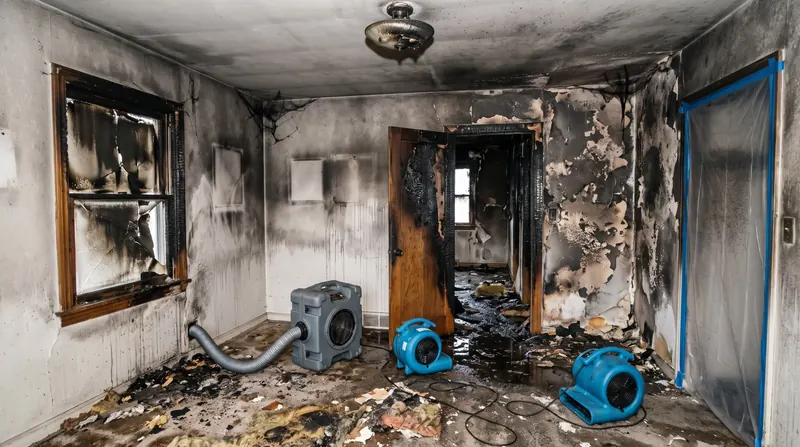
Burned room with a cracked, charred window, a scorched door and peeling walls, fallen debris on the floor, and an air scrubber and air movers running
Illustrative photo of heavy fire damage inside a house. It is not a photo of the Ridgefield Park homes.

What a proper job looks like. The side window gets boarded and the deck area secured. Water comes out of the basement and the side wall is opened and dried. The attic insulation, which holds smoke like a sponge, is removed. Walls and ceilings are cleaned dry first, then sealed. Clothes go out for specialty cleaning. Air scrubbers run, and the odor gets checked before anything is closed up. The family's own homeowners policy is the first stop, including what it pays for living elsewhere while the work goes on.

The lesson. If a fire happens next door, get your own house checked, even if it looks fine from the curb. Smoke and hose water don't respect property lines.

11

After the Fire: Water, Mold and Claim Help Across Bergen County

12

Fire Damage Calls From Hackensack 07601 and the Mutual Aid Towns Around It

House fires in this part of Bergen County pull in the neighbors. Teaneck, Englewood and Hasbrouck Heights backed up Hackensack in December 2025; Hackensack and Englewood crews went to Teaneck in July 2025; and Hackensack crews were among 14 departments in Ridgefield Park in April 2026. Calls for fire and smoke cleanup come from the same towns.

01

Hackensack Sections: Fairmount, Prospect Avenue, Main Street and Johnson Avenue

Calls come from Fairmount's older one- and two-family homes, the Prospect Avenue high-rises, the newer buildings downtown along Main Street and the homes off Johnson Avenue. More on fire, water and mold calls in Hackensack.

02

Towns Around Hackensack: Ridgefield Park, Teaneck, Bogota, Maywood, River Edge and Paramus

Ridgefield Park 07660, Teaneck 07666, Bogota 07603, Maywood 07607, River Edge 07661 and Paramus 07652. Calls from Teaneck, Paramus and Fort Lee are connected the same way, and the full list of towns is on the Bergen County service area page.

In Middlesex County, the Woodbridge and New Brunswick pages cover recent apartment fires there. Calls from Edison and the rest of the Middlesex County service area are connected the same way.

Call any time

Smoke Still Hanging in the House? Call (201) 409-9820 and Get Connected With a Fire Crew Serving Bergen County

Calls answered 24/7. For fire, smoke and soot in Bergen County homes. If the fire is still burning, call 911 first.

Undercroft Restoration is a free referral service, not a restoration company. Calls are connected to independent local service providers that serve your area, and calls may be recorded. The work is done by those providers, not by this site.

Pick the number for your problemServing Bergen and Middlesex Counties, NJ ยท Calls answered 24/7
Questions

What Bergen County Families Ask After a House Fire

Still have a question?

Calls answered 24/7. Pick the number for your problem, then say your town and what happened.

What should I do first after a house fire in New Jersey?

Stay out until fire officials release the building, and leave the gas and power off. Call your insurer, photograph the damage from a safe spot, get openings boarded up, and keep every receipt, including hotel and meals. Don't sign a public adjuster contract that night.

Is it safe to stay in a house with smoke damage?

It depends how far the smoke spread. Soot particles irritate the lungs, and the smell is a sign residue is still there. Kids, older relatives, anyone pregnant or with breathing problems, and pets are better off elsewhere until the house is cleaned.

Can smoke-stained walls be cleaned, or do they have to come out?

Sound drywall with surface residue can usually be cleaned and sealed. Drywall that's charred, blistered by heat or soaked by hose water comes out. A written scope should say which is which, room by room, and why.

Can I clean soot myself?

A small patch of light, dry soot, maybe: gloves, a mask and a dry chemical sponge, never a wet rag first. Large areas, oily soot from a puffback or a kitchen fire, and anything in the ductwork need a crew with the right equipment.

Why does the smoke smell come back on humid days?

Residue left in porous materials or inside wall cavities releases odor again with heat and humidity. If the smell returns in summer, the source wasn't fully removed or sealed. That's why the odor check should happen before walls close.

What happens to food, clothes and electronics after a fire?

Throw out food exposed to heat, smoke or firefighting chemicals, including what's in the fridge. Clothes usually come back with specialty cleaning. Don't switch electronics on until they've been checked, because soot and moisture inside can damage them.

Does homeowners insurance cover smoke damage from a neighbor's fire?

Usually the claim goes to your own policy, even though the fire started next door. Your insurer may then pursue the neighbor's carrier. Check your policy wording, and see the insurance claims help page for documentation and NJ claim deadlines.

What affects the cost of fire restoration in Bergen County?

How far smoke spread, the residue type, how much is charred, how much hose water got in, how many belongings need cleaning and how big the rebuild is. Call (201) 409-9820 and ask the company for a written scope before any work starts.

How long before the family can move back in?

After light smoke damage, often days to a couple of weeks. After structural fire damage, rebuilding can take months, and insurance approvals set much of the pace. Ask the company for a timeline in writing and check what your policy pays for living elsewhere.

Can I call about fire or smoke damage in Teaneck, Paramus or Fort Lee?

Yes. Calls from Teaneck, Paramus, Fort Lee and towns across Bergen County are connected with companies that serve those areas.

Call (201) 409-9820Water, Fire, Mold & Sewage